



The Networking and Career Development Center for Research in the South-Muntenia
Region (CNDCSM), created within Valahia University of Targoviste, highlights a relevant scientific result in the field of modern electrical energy systems: a new analytical approach for understanding how non-sinusoidal operating conditions influence reactive and apparent power in electrical networks.
The research addresses a practical challenge faced by contemporary power systems. As electronic equipment, power converters, renewable energy interfaces and automated industrial devices become increasingly present, electrical networks operate more often under distorted waveforms. These distortions, commonly described through harmonics, affect energy quality, increase losses, complicate system diagnosis and may reduce the reliability of equipment connected to the grid.
The scientific contribution promoted through CNDCSM proposes a sensitivity-analysis method that makes it possible to observe, quantify and compare the influence of individual harmonic components on the behaviour of reactive and apparent power. Instead of treating power-quality disturbances as a general effect, the method separates their impact and offers a clearer picture of the mechanisms that shape the electrical response of a system.
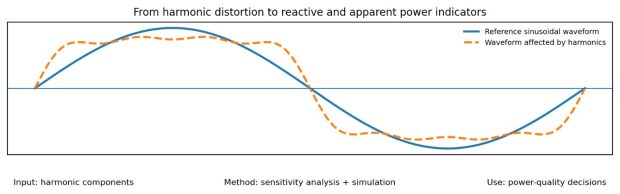
A central result is the combination of theoretical modelling with a simulation model implemented in MATLAB/Simulink. This allows the proposed relations to be checked in controlled scenarios and supports comparison between analytical values and simulated behaviour. The reported outcome is high precision and very low error in evaluating electrical-system behaviour under distorted waveforms, which increases confidence in the method as a decision-support instrument.
A key result of the work is the development of mathematical relations and a simulation model that can support engineers in evaluating complex operating regimes with a high level of precision. The model can be used to test scenarios, compare the effect of different harmonic components and identify situations in which power-quality problems can become significant for the stability and efficiency of electrical infrastructure.
This type of research is important because electrical energy quality is no longer a topic limited to generation and distribution companies. It directly affects manufacturing plants, public institutions, research laboratories, digital infrastructure, smart buildings and households. A more accurate evaluation of non-sinusoidal regimes can support better decisions when designing, monitoring or upgrading energy systems.
For the South-Muntenia Region, the result demonstrates the capacity of research teams connected through CNDCSM to produce knowledge with technical relevance and potential applicability in industry, energy management and digital transformation. It also shows how advanced mathematical modelling can be translated into instruments that help specialists anticipate problems before they become operational risks.
Beyond the technical contribution, the study has an educational value for students, doctoral candidates and young researchers interested in electrical engineering, automation and applied mathematics. It illustrates how a research question can start from a real engineering difficulty, move through theoretical modelling and simulation, and return to practice as a useful decision-support tool.
By promoting such results, CNDCSM contributes to the visibility of scientific research developed in research, development and innovation organisations from the region and encourages a research culture oriented towards quality, interdisciplinarity and practical impact. The centre’s role is not only to communicate scientific achievements, but also to connect them with career guidance, institutional cooperation and the needs of society.
The research confirms that the transition towards smarter and more efficient electrical networks requires more than new equipment. It also requires rigorous methods for analysis, validation and interpretation. In this context, CNDCSM supports the dissemination of scientific results that can strengthen the link between university research, technological development and sustainable regional progress.
Acest material a fost scris și redactat de echipa UV Târgoviște. Informațiile prezentate în acest material nu reflectă nici într-un mod opiniile echipei #diez.